ISO/IEC 42001:2013
Artificial Intelligence Management System (AIMS) (ISO/IEC 42001:2023)

The purpose of the ISO/IEC 42001 - Internal Auditor Certification is to demonstrate that the professional has a practical understanding of the terminology, structure, and considerations for the definition, implementation, monitoring, and auditing of an Artificial Intelligence Management System; following the guidelines of ISO/IEC 42001 and ISO 19011.

Verifiable digital credential
Online · Proctored
30 PUCs
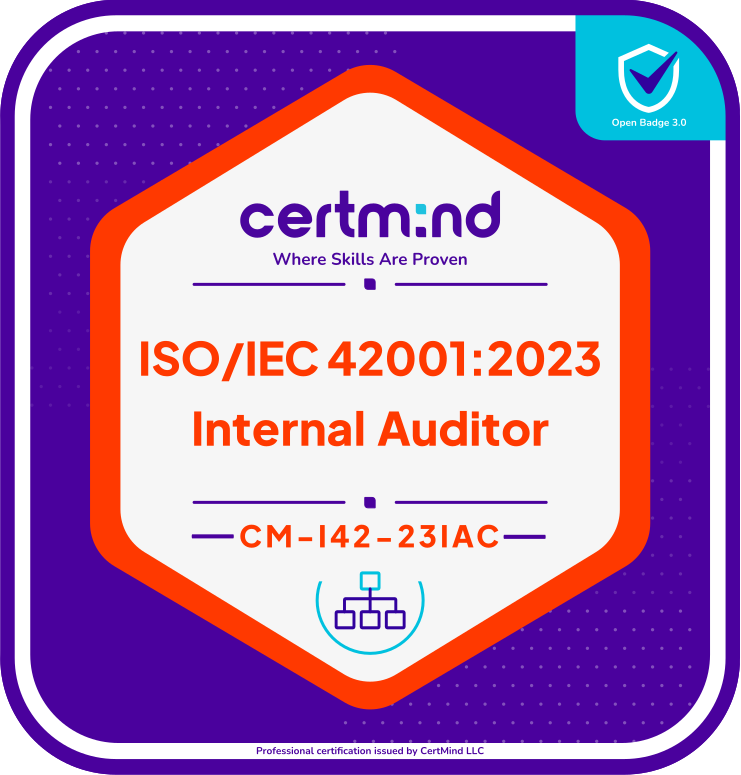
ISO/IEC 42001:2013 Badge
ISO/IEC 42001:2013
CertMind International
Verifiable digital badge
Category
ISO Standards
Exam price
US$ 99
Validity
5 years
Continuing education
30 PUCs
Modality
Online · Proctored
Official syllabus
1st standard
First certifiable AI management system standard
38 controls
Annex A controls assessed for responsible AI
5 years
Validity of the credential once obtained
30 PUCs
Continuing education required to renew the credential
AI governance

What is ISO 42001?

ISO/IEC 42001 is the first international standard for Artificial Intelligence Management Systems. It defines requirements to develop, provide, and use AI responsibly within a formal, risk-based management system.

It helps organizations govern how AI is designed and operated: defining policy and accountability, assessing impacts on people and society, applying controls throughout the AI life cycle, and generating evidence for audit and continual improvement.

Establishes accountability and policy for organizational AI use
Requires impact assessment on individuals, groups, and society
Creates auditable evidence across the AI system life cycle
AIMS Elements
Context
Interested parties, scope, and AI roles
Policy
Commitment, objectives, and accountability
Risk
Risk assessment and AI impact assessment
Controls
Annex A measures across the life cycle
Improvement
Audit, management review, and corrective action
Candidate profile

Who should take this certification?

Designed for professionals who work with technology or want to enhance their skills with an internationally recognized credential.

AI governance and compliance leads

Professionals who must demonstrate that the organization uses artificial intelligence responsibly and in line with emerging regulation.

Best fit when: Build the AI policy, define accountability, and prepare the organization for external assessment.

Internal auditors

Auditors who need to extend their management system practice to artificial intelligence using ISO 19011 methodology.

Best fit when: Plan, execute, and report AIMS audits with defensible criteria and evidence.

AI and data science leads

Technical leaders responsible for models in production who need a governance frame around their work.

Best fit when: Connect model life cycle practices with documented controls and impact assessment.

Risk and data protection officers

Roles accountable for the effect of automated decisions on individuals and groups.

Best fit when: Run AI impact assessments and integrate them into existing risk treatment.

Assessed content

Assessed competencies

Knowledge and capabilities supported by this certification at an international level.

Competency 01

Identify and master basic concepts, terminology, and organizational context for developing an AIMS.

Competency 02

Determine interested parties, scope, and boundaries of the Artificial Intelligence Management System.

Competency 03

Evaluate leadership, commitment, roles, and the artificial intelligence policy of the organization.

Competency 04

Define and assess AI risks and opportunities, including impacts on individuals, groups, and society.

Competency 05

Apply artificial intelligence impact assessment as a required input to risk treatment.

Competency 06

Identify resources, competencies, awareness, and documented information needed to operate an AIMS.

Competency 07

Evaluate, plan, implement, and control the processes required to achieve AIMS objectives across the AI system life cycle.

Competency 08

Assess performance evaluation, internal audit, and management review of the AIMS.

Competency 09

Understand Annex A controls and the implementation guidance of Annex B for responsible AI.

Competency 10

Apply ISO 19011 audit guidelines to plan, execute, report, and close management system audits.

Credentials

Your official badge and diploma

Upon passing you receive verifiable digital credentials you can share on LinkedIn and present to employers.

Digital Badge

Verifiable digital credential compatible with Open Badges 3.0. Share it on LinkedIn, email, or your personal website.

ISO/IEC 42001:2013 - CertMind Badge
Open Badges 3.0 Verifiable online Permanent

Official Diploma

PDF diploma digitally signed with authentication QR code. Printable in high resolution.

CertMind Diploma
Digital signature QR Code High resolution
Path to credential

From knowledge to certification

A path designed so you arrive prepared and obtain a credential that validates your level of expertise.

1

Explore the syllabus

Download the official syllabus and understand the assessed competencies. Identify your gaps.

2

Prepare with a partner

Access our network of certified training partners with exam-aligned courses in your region.

3

Take the exam

Online exam with remote proctoring. 50 questions, from anywhere in the world.

4

Get your credential

Upon passing, you receive your verifiable digital badge and official diploma ready for LinkedIn.

How to access

Get certified through a training partner

CertMind does not teach courses — our network of certified training partners offers official preparation.

Individual exam

No prior course
USD 99
one-time payment
  • For those who already have experience
  • Online proctored exam
  • Digital badge + diploma
  • Valid for 5 years
Get a voucher
Professional impact

What certified professionals achieve

This certification validates competencies that apply to real challenges in teams and organizations.

Auditable AI governance

Certified professionals turn responsible AI principles into documented controls, evidence, and decisions that hold up under audit.

Readiness for AI regulation

They prepare the organization for regulatory scrutiny and customer due diligence with a recognized management system frame.

Trustworthy AI in operation

The credential validates the ability to assess AI impacts, apply Annex A controls, and sustain continual improvement.

Official material

Download the official Syllabus

The syllabus details the assessed competencies, area weights, and recommended bibliography. Available in English and Spanish.

Syllabus in English

Download Syllabus in English · PDF

Syllabus en Español

Download Syllabus in Spanish · PDF

Frequently asked questions

Everything you need to know

What is the difference between ISO 42001 and ISO 27001?

ISO 27001 manages information security; ISO/IEC 42001 manages artificial intelligence. They share the same management system structure, so an organization can integrate both, but ISO 42001 adds requirements that have no equivalent in ISO 27001 — most notably the AI impact assessment on individuals, groups, and society, and controls covering the AI system life cycle.

Do I need a technical background in machine learning?

No. The certification assesses management system and audit competencies, not model development. Familiarity with how AI systems are built and operated helps you interpret evidence, but the exam does not require programming or data science skills.

Is it useful if my organization only buys AI, and does not build it?

Yes. ISO/IEC 42001 explicitly covers organizations that develop, provide, or use AI systems. If you procure and operate third-party AI, the standard gives you criteria to assess suppliers, define responsibilities, and document the controls you rely on.

Does this certification make my organization ISO 42001 certified?

No. This is a personal credential that validates your competencies as an internal auditor. Organizational certification is a separate process carried out by an accredited certification body, though certified internal auditors are usually a prerequisite for reaching it.

Why do certifications expire?

Certifications expire because frameworks, technologies, and best practices evolve constantly. Expiration ensures that certified professionals stay current with industry standards and continue developing their skills. This maintains the value and credibility of the certification in the job market.

How can I renew my certification?

You can renew your certification by accumulating Professional Update Credits (PUCs) through work experience, training courses, or professional development activities. Before your certification expires, submit your renewal application through the CertMind platform with the required PUCs documented.

What happens if my certification expires?

If your certification expires, you will need to go through the recertification process, which typically involves retaking the exam. We recommend starting your renewal process well before the expiration date to avoid any gaps in your certified status.

Can I take the exam in my native language?

Yes, CertMind offers exams in both English and Spanish. You can choose your preferred language when scheduling your exam. All study materials and syllabi are also available in both languages to support your preparation.

Related Certifications

For institutions and trainers

Are you a trainer or educational institution?
Become a CertMind partner

Offer international certifications to your students and strengthen your academic programs with exam vouchers, official materials, and globally recognized credentials.

Access to official materials
Partner pricing for vouchers
Visibility in the CertMind directory
Dedicated pedagogical support
Start today

Ready to get certified in
ISO/IEC 42001:2013?

Prepare to audit artificial intelligence management systems with ISO/IEC 42001 criteria. Find a training partner or download the syllabus.